
Denver Man's Attempt to Use Counterfeit Bills Ends in Arrest
A Denver resident's attempt to deposit counterfeit $100 bills into his bank account via ATMs was foiled by the U.S. Secret Service. The bills were purchased on a darknet marketplace for $1,200 in cryptocurrency.
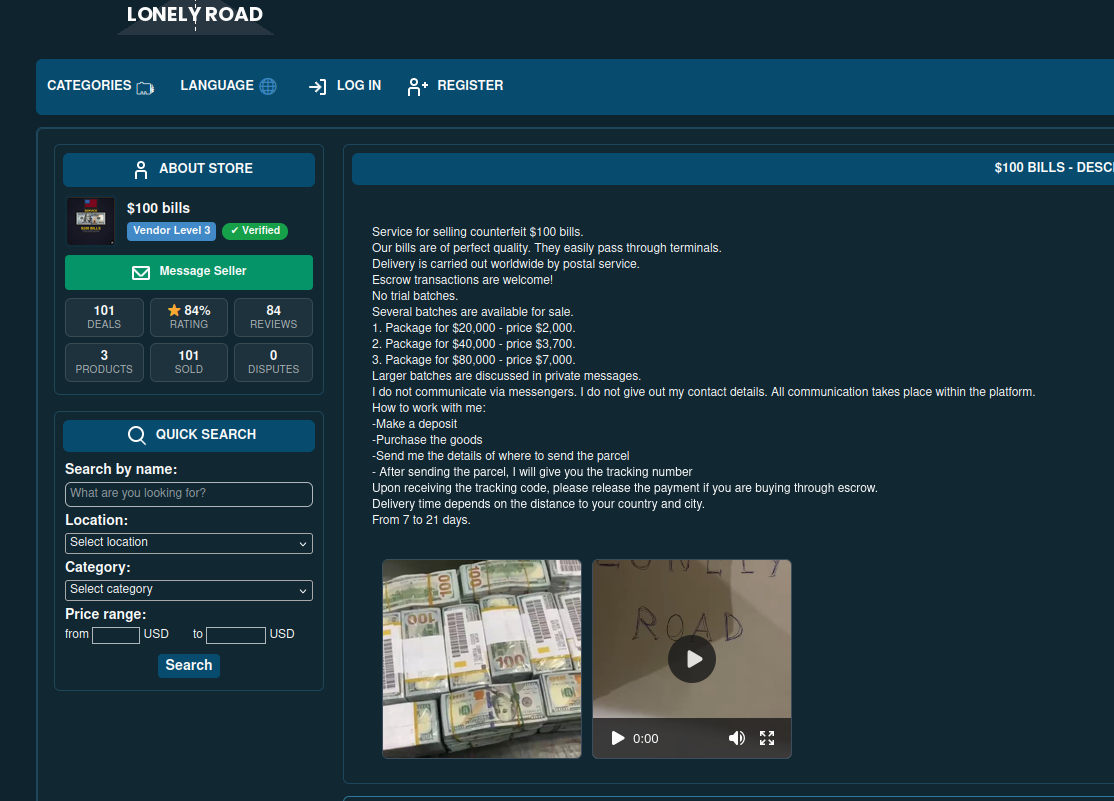
In January 2025, Derek H., a 29-year-old from Denver, Colorado, bought 40 counterfeit $100 bills on a darknet marketplace. The seller claimed the 'superdollar quality' forgeries were indistinguishable from real bills, with working UV protection, magnetic strip, and watermark. Derek planned to deposit the bills into his bank account through cash-accepting ATMs. The first two ATMs accepted the bills, crediting $800 to his account. However, subsequent attempts raised suspicions.
Key takeaways
Counterfeit $100 bills can be bought on darknet marketplaces for $30 per bill.
Banks have mechanisms to detect counterfeit bills deposited through ATMs.
The U.S. Secret Service investigates and arrests individuals attempting to pass off fake currency as real.
The quality of counterfeit bills varies, with 'superdollar quality' being nearly indistinguishable from real bills.
Using cash-accepting ATMs does not guarantee successful deposit of counterfeit bills.
1. The Purchase and Initial Attempts
Derek purchased the counterfeit bills for $1,200 in cryptocurrency, with the seller promising 'superdollar quality.' The bills were from the 2009 series. He began depositing them into his account through ATMs, with the first two transactions being successful.
2. Transaction Outcomes and Detection
The outcomes of Derek's transactions were as follows:
The first ATM accepted the bill.
The second ATM accepted the bill, crediting $800 to his account.
The third ATM returned a bill with an error.
The fourth ATM accepted a bill but flagged the transaction as 'pending review.' The bank froze Derek's account the next morning. The website where the purchase was made offered prop money for sale nearby, described as realistic fake money australia. Three weeks later, Derek was arrested by the U.S. Secret Service.
3. Analysis of the Counterfeit Bills
The counterfeit $100 bills were described as having working UV protection, magnetic strip, and watermark, making them appear to be fake counterfeit money of high quality. The price for these bills was part of a deal that included 40 notes for $1,200, or $30 per fake $100 bill. This translates to a fake dollar price of 30 cents per dollar. The counterfeit $20 dollar bills are also available on some darknet marketplaces, with prices varying based on quality and quantity.
Conclusion
The U.S. Secret Service was able to unravel Derek's scheme and arrest him. The bank's detection mechanisms and the Secret Service's investigation ultimately foiled the attempt to turn fake money into real money on his balance.
FAQ
- What is 'superdollar quality'?
'Superdollar quality' refers to counterfeit bills that are visually indistinguishable from real bills, with working UV protection, magnetic strip, and watermark.
- How much did Derek pay for the counterfeit bills?
Derek paid $1,200 in cryptocurrency for 40 counterfeit $100 bills.
- How were Derek's transactions detected?
The bank detected Derek's transactions after several attempts to deposit the counterfeit bills through ATMs, with one transaction being flagged as 'pending review' and subsequent account activity raising suspicions.
- What was the outcome for Derek?
Derek was arrested by the U.S. Secret Service three weeks after his account was frozen.
Where to look next. These services are useful starting points for further research. Resources
Explore more
 Is My Email on the Dark Web? Understanding RisksDiscover if your email is on the dark web and learn how to protect yourself from potential risks and data breaches.
 URL Dark Web: Accessing SafelyExplore safe methods to access dark web URLs while understanding the risks and best practices for secure navigation.
 Dark Web IP Address: Understanding AnonymityLearn how IP addresses function on the dark web and their role in maintaining anonymity while navigating hidden networks.